



Flight Information
Environmental Conditions:
Propulsion System
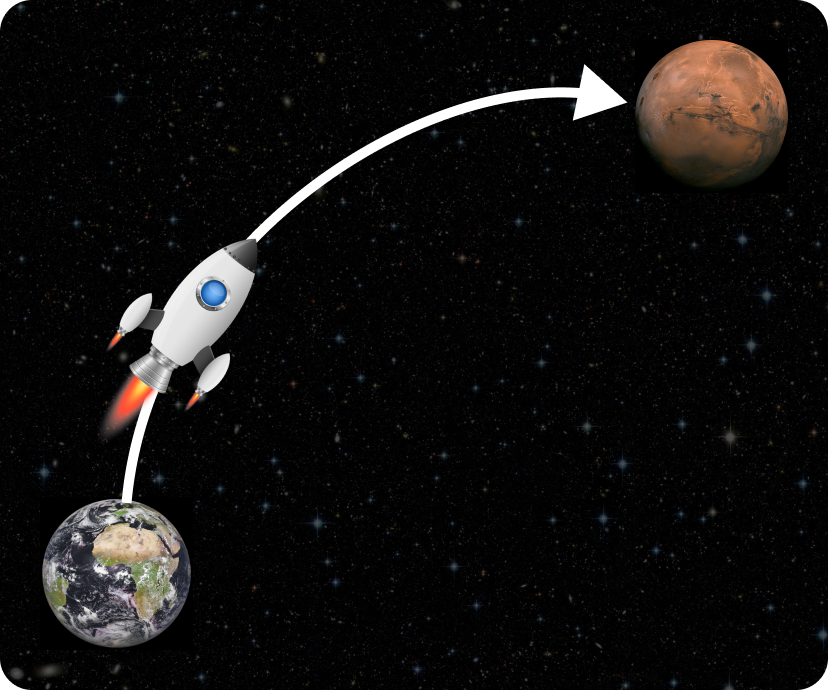
Type: High-thrust chemical rockets (traditional) or advanced propulsion systems like nuclear thermal propulsion (NTP) or ion drives for efficiency.
Delta-V Requirements:
Earth escape velocity: ~11.2 km/s.
Mars transfer: ~3-6 km/s depending on trajectory.
Mars orbital insertion or descent: ~2-4 km/s.
Total Delta-V: ~15-20 km/s.
Why it's Critical:
The propulsion system provides the thrust required to:
Escape Earth's gravity.
Travel through interplanetary space on a trajectory to Mars.
Adjust the spacecraft's course en route.
Slow down for Mars orbit insertion or landing.
Life Support System
The life support system sustains the crew by managing air, water, food, waste, and radiation protection.
Key Functions:
Oxygen Production & CO2 Removal: Continuous supply of breathable air and scrubbing of toxic gases.
Water Recycling: Reclaiming water from humidity, urine, and other waste sources.
Food Storage & Waste Management: Long-duration food storage and disposal of waste materials.
Radiation Protection: Shielding against cosmic rays and solar particle events to prevent long-term health risks.
Reliability: Must function autonomously with minimal resupply options and allow for redundancy in case of failure.
Why it's Critical:
Sustaining the crew during a months-long journey in a hostile environment is essential to the mission's success.